Winter Temperatures Inside a Michigan Polyhouse
Current Weather · Forecast Products
|
Conditions beneath the plastic: winter temperatures inside a Michigan polyhouse Jeff Andresen, Geography, Tom Dudek, Landscape/Nursery District Agent, and Bert Cregg, Horticulture and Forestry Early this year, a new automated weather station, sponsored by contributions from the nursery/ornamental industry in western Lower Michigan, was installed at Northland Evergreens, Inc. near West Olive as part of the Michigan Automated Weather Network (observed weather data from this station are available via in internet at http://www.agweather.geo.msu.edu/AWO/Current/Automated/). At the same time, a datalogger and temperature probes were installed to monitor temperatures inside an adjacent polyhouse covered by material with a 55% shading factor. Indoor temperatures were monitored in the air at a 2 foot level and in planting medium in two nearby 1 gallon plastic containers at a 1 inch depth. As is the case for all air temperatures monitored in the MAWN network, all temperatures were sampled by the dataloggers every 60 seconds with data output recorded as absolute maxima and minima every 24 hours and hourly averages every 60 minutes. Daily minimum temperatures and accumulated base 50F growing degree day totals from January 10th through May 2nd of this year for locations inside and outside of the polyhouse are given in Figures 1 and 2, respectively. As can be seen in the figures, the temperature moderating effects of the polyhouse were significant. Absolute minimum temperatures during this period were 1.4F, 11.9F, 28.2F, and 27.4F, for outside air, inside air, inside container medium #1 and inside container medium # 2, respectively. Greatest differences in air temperature between inside and outside the polyhouse exceeded 40F on some bright, sunny days during March, April, and May (data not shown). During nighttime/early morning hours on relatively clear, calm nights when radiational cooling was strong, indoor/outdoor differences were as much as 10F (see figure 1). Container medium temperatures inside the polyhouse were very similar in both containers and remained close to the freezing mark prior to day 90 (March 31st), after which warmer temperatures thawed the medium and resulted in greater day to day temperature fluctuations. Growing degree day totals derived from the temperature data inside the polyhouse during this period were consistently greater than those from the outside air temperatures, with a difference of more than 225 units as of May 2nd. From Figure 2, this translates roughly into a difference of 25-35 calendar days (i.e. phenologically, one would expect to reach a given growth state 25-35 days earlier inside the polyhouse versus outside). The 200+ additional GDDs in the early season are also significant from a climatological perspective, representing from 5-15% of the entire (outdoor) growing season base 50F total GDD accumulation for this area of west central Michigan. And the physical reasons for the differences? A common perception is that solar radiation (shortwave) is generally able to pass in through the top of the polyhouse while outgoing (longwave infrared) re-radiation cannot or is greatly reduced, thereby trapping some of the intercepted heat energy within the structure (the 'greenhouse effect') and warming the interior. While this radiative characteristic certainly is a factor in explaining the differences, the complete answer is more complicated. In general, the temperatures of most vegetated surfaces on earth are the result of a radiative balance of several key factors; net long- and shortwave radiation (i.e. the greenhouse effect mentioned above), energy flux due to evaporation or condensation, energy flux associated with convective loss or gain (e.g. from wind), and energy flux into or out of the soil profile below. In terms of magnitude of the daily surface energy balance terms for a vegetated, mid-latitude location during the growing season, the net radiation term would typically be largest, followed by evaporation, convection, and ground flux terms. Thus, heat energy radiatively trapped inside such a structure does provide a significant fraction of the observed warming (note the differences between indoor and outdoor daily minimum air temperature on clear, calm nights in Figure 1). We must also consider, however, that the structure also prevents heat from leaving (assuming the polyhouse is closed to the outside environment) through convective loss of both water vapor (in which energy was consumed during evaporation) and heat associated with the surface itself (e.g. heat generated by plant surfaces warmed in the sun). The behavior of the ground flux term is similar to that of a natural surface, but can vary in magnitude depending on the composition of the polyhouse floor (soil, concrete, etc.) and because some of the outgoing longwave energy released at night is trapped by the polyhouse material. Past microclimatic research in such structures has shown reduced convection can be as important as the net radiation balance term during certain parts of the day (especially daytime hours). Thus in summary, the polyhouse or greenhouse is an effective way of lengthening the growing season in temperate climates, and is due both to the special radiative characteristics of glass or plastic and to the relative shelter the structure provides from the outside environment. 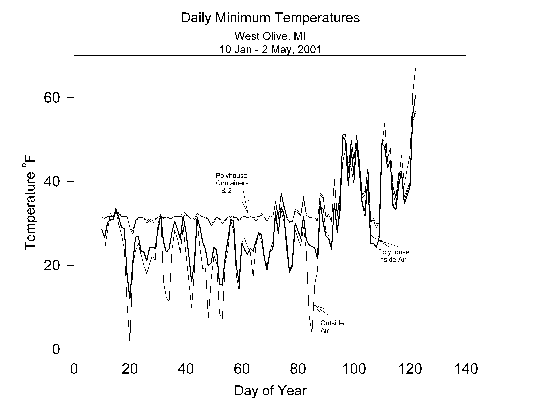 Figure 1. Daily minimum temperatures within a polyhouse, at West Olive, MI, 10 JAN 2001 - 2 MAY 2001. Figure 1. Daily minimum temperatures within a polyhouse, at West Olive, MI, 10 JAN 2001 - 2 MAY 2001.
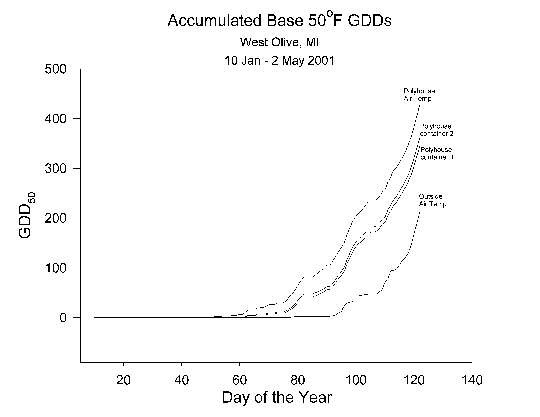 Figure 2. Daily base 50F growing degree day accumulations within a polyhouse at West Olive, MI, 10 January
2001 - 2 MAY 2001. Figure 2. Daily base 50F growing degree day accumulations within a polyhouse at West Olive, MI, 10 January
2001 - 2 MAY 2001.
|